HARUMOI HOSONO
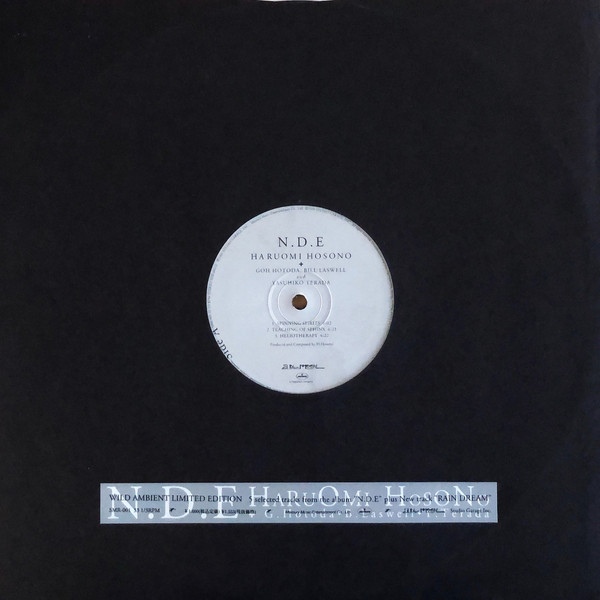
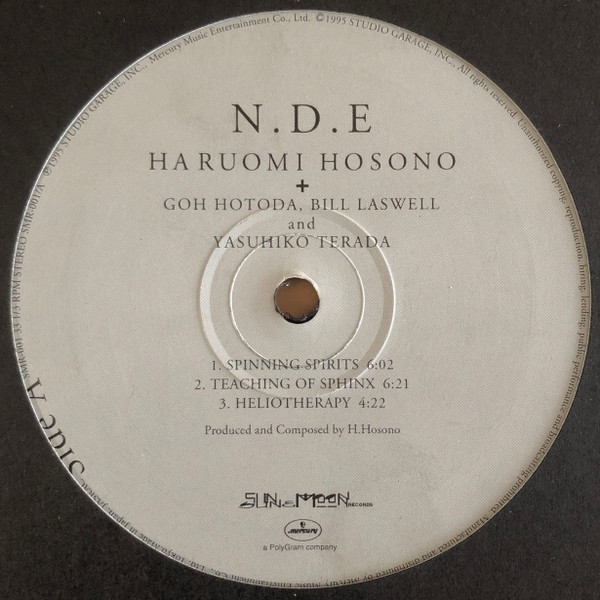
  1/  Spinning Spirits                            (Hosono)                    6.02
  2/  Teaching of the Sphinx                      (Hosono)                    6.21
  3/  Heliotherapy                                (Hosono)                    4.22
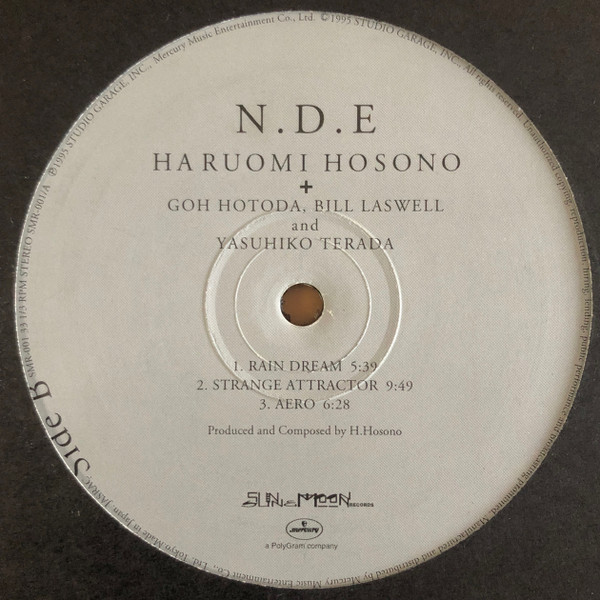
  4/  Rain Dream                                  (Hosono)                    5.39
  5/  Strange Attractor                           (Hosono)                    9.49
  6/  Aero                                        (Hosono)                    6.28

          Recorded at Think Sync Studios, Tokyo
          Track 3 recorded at Racoon Studio, Tokyo
          Track 4 additional recording done at Greenpoint Studio, Brooklyn,
            New York
          Track 5 recorded at Funky Slice Brooklyn Studio, New York City
          Track 6 recorded at Racoon Studio, Tokyo and Funky Slice Brooklyn
            Studio, NYC
          Produced by Haruomi Hosono
          Additional production on track 2 by Francois Kevorkian
          Additional production on track 4 by Bill Laswell
          Additional production on track 5 by Ayumi Obinata
          Additional production on track 6 by Goh Hotoda
Haruomi Hosono: sounds, programming; Junichi Yajima (1): programming; Yoshiko Oda (1): voice; Arun Bagal (5,6): violin; Jen Monnar (5,6): guitar.
1995 - Sun & Moon/Mercury (Japan), SMR-001 (Vinyl)
Haruomi Hosono has produced so much music over the past six decades that he often can't remember much about making it. In his early musical pursuits, the Japanese legend committed himself to creating "sightseeing music", and exhibited the curiosity of an idealistic nomad in his exploration of exotica, psychedelic folk, J-pop, Eastern music and ultimately, later in life, ambient and electronica. As a former member of two career-defining Japanese bands, Happy End and Yellow Magic Orchestra (YMO), his early and mid-career works retained the imprint of his lifelong love for American music. Lesser known in his catalogue are the dense and world-building ambient techno records he released in the '90s and early '00s—a time when he collaborated with the likes of Japanese experimentalists Tetsu Inoue and Miharu Koshi, and worked with vital names in the burgeoning illbient scene, such as Bill Laswell and The Orb.
Recent reissues have begun calling attention to the solo work following his 1984 departure from YMO. In the '90s, Hosono started his own Daisyworld label, which signaled his entrance into the abstract haze of his most adventurous electronic music production. N.D.E., a 1996 sojourn through ambient, trance and tabla rhythms, was the pinnacle of this musical era, though it would also ultimately close his solo explorations within it. "Ambient represented a musical and psychological reset for me," he told RA in 2018. "As the new millennium dawned and the 21st century began, that period of reset ended."
N.D.E. is by turns swampy, deliriously haunting, transcendent and contemplative. Its textural makeup is complex, joining the bleeping psychedelia of Hosono's 1978 album influenced by his trip to India, Cochin Moon, the spacious ambient and acid house of 1993's Medicine Compilation From The Quiet Lodge (on which he paired up with ambient legend Laraaji) and the uplifting New Age pop of his 1995 project Love, Peace & Trance. N.D.E. features a genre-defying cabal of collaborators, including house pioneer François K, Yasuaki Shimizu—an innovator within sparse electropop—and Laswell, who lent his smoke trails of '90s dub to the record.
The album sounds like it could have easily been put out today, especially considering modern electronic music's fixation on mid-'90s nostalgia. The album is best appreciated with headphones, as percussion snakes from one ear to the next, and more delicate sounds come to life through insect chatter or the faintest chime. On "Spinning Spirits," whispered consonants glitch and blur, while tabla rhythms, speaking to Hosono's love for Indian composition, flit in and out like a mosquito suddenly finding its way near an ear before being swiftly swatted away. [...] Earlier on the LP, Arun Bagal's eerie violin wisps give "Strange Attractor" a funereal resonance, and a nu jazz-like cacophony of squeaking and twisting acoustic and electronic instruments joins. Ultimately, it is all gracefully usurped into bouncy progressive house.
Other sections of N.D.E make clear why Hosono's '90s and '00s works are often likened to albums from ambient techno greats like The Orb. [...]
When the album's activity recedes, the busyness passes over to unveil calm, verdant land. The spacey dub of "Teaching Of Sphinx" underlies the all-consuming reverberations of what sounds like church bell chimes recorded from great heights. Carrying the playful energy of Hosono's 1986 album, Video Game Music, "Heliotherapy"'s arpeggios are bright, airy and bursting with life. Closing the album is one of Hosono's most beatific accomplishments—"Aero," home to winding violin, distant bird cries and cotton-candy sweet melodies fit for a music box.
Hosono's interest in releasing solo electronic albums after N.D.E. might have declined, but his influence was certainly felt across the electronic music world. His Daisyworld imprint was home to releases from Mixmaster Morris, Atom Heart and Jonah Sharp. In the early '00s, he would debut the sweetly sung, nostalgic electronica of his collaboration with his former YMO bandmate Yukihiro Takahashi, Sketch Show. The music he made and championed in his later years materialised his insatiable curiosity for all manner of sounds, resulting in a gorgeously textural meeting of ambient, drone, deeply melodic electronica and Easterns sounds that proved his genius in producing timeless and enticing sound collages, regardless of genre.
Kiana Mickles (courtesy of the Resident Advisor website)
[culled from a longer review of the 2023 reissue]
For many pioneers of electronic pop music, the 1990s presented an identity struggle beyond the usual midlife crisis. Synths and drum machines were now widely accessible and ubiquitous: your $4000 synth isn't so special anymore, your $5000 sequencer that constantly broke down on stage is a relic of the distant past, and any Detroit techno producer, Manchester acid house enthusiast, or some smiling dude from Cornwall could render your entire career obsolete. Past innovators mostly trudged through this era, attempting merely to stay afloat in the market. In 1991, Kraftwerk reworked (you could say ruined) their classics with "modern" digital synths on The Mix, while Brian Eno spent the decade churning out meandering ambient works, reaching his nadir with 1997's The Drop, a 74-minute CD of him redundantly pressing buttons to produce possibly the most grating sounds imaginable.
In 1993, Yellow Magic Orchestra reunited for Technodon, an ambient house record that unlike their original run of LPs from 1978-1983, found them catching up to everyone half their age instead of breaking new ground. Electronic music was now a full-fledged industry with its own section at your local CD emporium, and styles changed drastically within months. Technodon is better than its reputation suggests, but it downplays the attention to detail and compositional flexibility that made YMO special. The individual members handled the 90s with varying artistic success: Yukihiro Takahashi started the decade with schlocky adult-contemporary balladry before adopting a more current downtempo sound; Ryuichi Sakamoto made some watered-down, guest-heavy pop records until correcting course with bare-bones piano works; Haruomi Hosono’s 90s output is harder to describe in one sentence.
Any pocket of Hosono's fascinating solo discography is dizzying, yet particularly schizophrenic during this time. Two months before Technodon, Hosono released Medicine Compilation From The Quiet Lodge, a "fourth world"/tribal ambient record showcasing his sense of stylistic exploration. In the liner notes, he said, "I used to often be referred to as a 'frontier musician' but these days, I think that the frontier of modern civilization is at the center of our hearts. The frontier = the heart. Isn't this perhaps the secret to ambient music? […] It’s possible to say that this album is my own clumsy prelude to the changes that are occurring as we enter the 21st century." "Sight seeing," or the observation and incorporation of music from around the world, is a recurring thread in Hosono's work. At a time when "world music" was a reductive catch-all for non-Western-originated music, Hosono created another sort of "world music": music that incorporated elements from around the world into a singular, unified hybrid accessible from any perspective. His pre-YMO late 70s works Paraiso and Cochin Moon planted the seeds of it, but it truly came to the fore on albums like 1989’s Omni Sight Seeing, 1993's aforementioned Medicine Compilation, and 1996's N.D.E, the latter an often overlooked ambient techno gem long out of print and now reissued on vinyl by Amsterdam record shop Rush Hour.
Information about N.D.E, at least in English, is scarce. Maybe Haruomi Hosono had an actual N.D.E.—near-death experience—or maybe it was just an academic fascination of his. The latter wouldn't be surprising, as Technodon features a spoken sample of John C. Lilly, the scientist who gave acid to dolphins and later first coined the term "near death experience." Whatever the case, the almost entirely instrumental N.D.E showed Hosono in the stylistic present of 1996 while maintaining and continuing to explore his own musical fascinations. Bassist Bill Laswell, saxophonist Yasuaki Shimizu, producers Francois Kevorkian and Goh Hotoda, and others contribute, yet it's distinctly Hosono in how sharply evocative it is. The entire record sounds like you're blasted at supersonic speeds through a dark tunnel while simultaneously blinded by a painfully bright light at the end—commonly reported elements of near-death experiences.
[...] it's a bit long, repetitive, and intense, not that that's a bad thing. "Spinning Spirits" starts the album with hypnotic tablas [...] "Teaching of Sphinx" is especially atmospheric and dubby, while the short "Heliotherapy" has those familiar bubbling 90s synths in the background. [...] Closer "Aero" ranks among Hosono's finest (that's saying something since there's a lot to choose from), its ambient drone capturing a feeling of coming back to one's earthly body yet floating towards a more enlightening place, whatever that is. Like much of Hosono’s 80s and 90s work, it's about sound images more than structure, which is only a loose frame. There's a lot of room for that to go wrong (and he's certainly got his duds), but when he gets it right, as he does in N.D.E’s best moments, it’s magical beyond adequate description.
[...]
Malachi Lui (courtesy of the Tracking Angle website)